Most "women's safety app" pitches stop at a panic button. Krishn Kavach — built as a Kotlin Multiplatform app with a Node/TypeScript backend — treats the panic button as the last resort, not the whole product. Before anyone has to press anything, the phone is already watching ambient light, sound, motion and location for the signals that precede trouble; and the moment it does need to raise an alarm, a real, verified person — a Rakshak — is already being matched to go stand next to her.
We're sharing exactly how it works below, and at the bottom of this post we explain why we're recruiting 7 volunteers from Delhi to test it end-to-end before launch.
What Is Krishn Kavach?
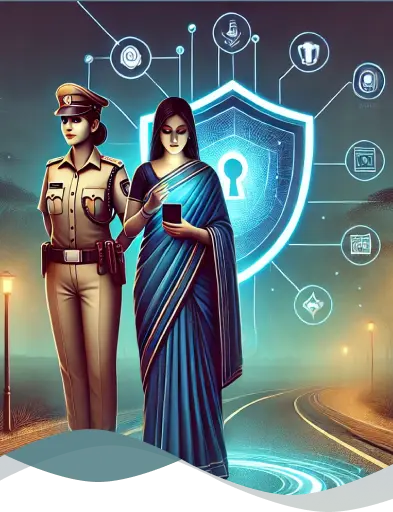
Krishn Kavach ("Krishna's shield") is a personal safety companion app for women, designed around one guiding rule: help must go out even when something fails. Every path that sends an alert has a fallback built in — push notification falls back to SMS, an internet-connected app falls back to an SMS intent, the nearest Rakshak falls back to the next Rakshak, and if nobody responds, the control room gets alerted directly.
The system has three people on it, not one:
- The woman (Safety User) — the person the app protects.
- Family (Trusted Contacts) — up to three people she chooses, who get alerted and can watch a live incident room the moment something goes wrong.
- Rakshak (Verified Responder) — an ID-verified volunteer nearby who gets dispatched to physically stand with her until her family arrives.
Step by Step: What the Woman Sees
1. Sign up with phone OTP
Login is Firebase phone OTP — no passwords. The backend verifies the OTP, creates her account, and issues a session token.
2. Build a safety profile
Registration isn't just a name and email. It captures details that actually matter in an emergency: name, age group, height, and whether she owns a vehicle (with details) — the kind of physical description a responder or family member would need to identify her quickly.
3. Save up to 8 frequent places
Home, college, tuition, a relative's house, temple — up to eight places she visits often, picked via Google Places autocomplete. This isn't just a contacts list. The app quietly learns her routine around these places: being out at night at a saved place is treated as normal; being out at night away from all of them, somewhere she's never been before, is what actually raises Alert mode.
4. Set two PINs — and only she knows which is which
Every woman sets two PINs at setup: a real Safety PIN and a duress Sarthi PIN. If someone is forcing her to "prove she's fine," entering the Sarthi PIN tells the app to report "resolved" on the surface — while the incident silently stays active behind the scenes. Nothing on her screen or anyone else's gives this away.
5. The phone is always reading the room
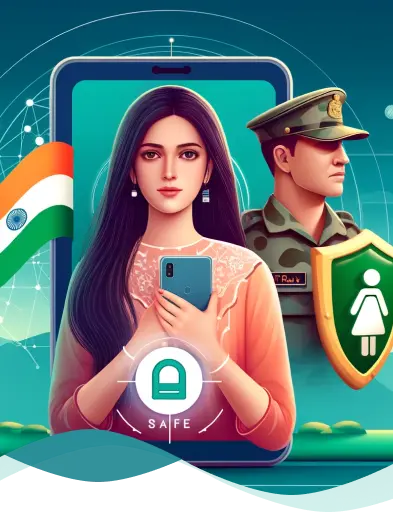
Once set up, the dashboard quietly monitors live signals: ambient light (complete darkness is a risk signal), sound level (a sudden spike above 80 dB), motion/accelerometer (extreme, sudden movement), gyroscope (sudden rotation — consistent with a struggle), proximity, and even heart rate, measured through the phone's own camera. A single signal alone can only nudge her into a quiet check-in; an automatic SOS only fires when two or more signals line up together, or a check-in goes unanswered — so a loud street or a dropped phone doesn't cry wolf.
On top of the always-on sensors, newer detection layers add: on-device Activity Recognition (being driven somewhere right after walking, at night, in an unfamiliar area), on-device Voice AI listening only for 10 seconds after a loud sound for screaming or distress phrases (audio never leaves the phone), a barometer catching a sudden change in height consistent with being taken indoors, and a deliberately hidden "shake pattern" — three bursts of shaking with calm pauses — as a silent, discreet SOS trigger.
6. Trigger Alert, or let the phone trigger it for her
There's always a manual "Trigger Alert" button front and center. But just as often, the incident starts automatically: an unanswered check-in, a heartbeat that goes silent for 90+ seconds while Alert mode is on, or two or more danger signals firing together.
What Happens the Moment an Incident Starts
This is the part most safety apps don't actually build — what happens in the seconds and minutes right after the alarm fires.
- ACTIVE. Her trusted contacts and the Krishn Kavach control room are notified immediately (push, with SMS as a guaranteed fallback). Dispatch starts at the same time — it doesn't wait for a human to approve it.
- Dispatch, always in pairs. The server searches Redis for verified Rakshaks online within 5 km and offers the incident to the nearest two at once. If nobody accepts within 30 seconds, it tries the next two, widening to a 10 km radius after three rounds and alerting the admin control room.
- RESPONDER_ASSIGNED. The first Rakshak to accept is locked in atomically — two Rakshaks can never end up assigned to the same woman by a race condition.
- Kavach code verification. A 4-digit code is generated the moment the incident opens and shown only to her. The Rakshak must read that code back to her on arrival before anything else happens — this is how she confirms the person walking up to her is actually who the app sent.
- RESPONDER_ARRIVED. The Rakshak stays with her at that exact meeting point. He does not walk her anywhere, does not get in a vehicle with her — he waits until her family physically arrives.
- RESOLVED. She closes it herself with her real Safety PIN.
Why it's always two Rakshaks, never one
No single person is ever trusted alone in this system — there's no "police" layer here; the safety comes from Kavach's own design rules:
- Dispatch always continues until two Rakshaks accept, lead and second.
- For a minor, or any incident between 10 pm and 5 am, the first two rounds only go to women Rakshaks — men are offered the incident only if no woman responder is free.
- She has a silent veto: one tap quietly removes a Rakshak from her incident. He sees nothing different on his own screen — no notification, no explanation — while new Rakshaks are dispatched behind him and her family and the control room are told.
- A background sweeper checks every Rakshak's conduct every 5 seconds: has he gone silent for 90+ seconds, is he moving unusually close to her while she's moving fast, has he wandered more than 400 m from the agreed meeting point, did he leave before her family showed up. Any of these quietly flags him, alerts her family and the control room — again, without tipping him off.
What Family Sees
Trusted contacts don't need to install anything special or be manually added by name — the link is by phone number, so if a parent installs the app later, the connection forms automatically. During an incident, they get a live incident room: her location trail updating in real time, a timeline of what's happening (dispatched, assigned, arrived, resolved), and if anything about the assigned Rakshak looks off, they're the first to know. Outside of emergencies, a Safe Journey share tells them her route and expected arrival time — never shared with Rakshaks, since her destination is often simply home — and pings them if she's 15+ minutes late.
What a Rakshak (Responder) Goes Through
Becoming a Rakshak isn't a toggle switch. Every responder registers with a live selfie and a government ID photo, and a real person at the control room reviews and approves or rejects the application by hand before that account can ever go online or receive an offer. Once verified:
- He goes online/offline and shares live location only while on duty — this position lives in Redis, not the main database, purely for fast "nearest N" lookups.
- He receives offers for nearby incidents with a 30-second window to accept.
- On accepting, he must get the Kavach code from her in person to confirm the match — he has no other way to "verify" he's with the right person.
- He's expected to stay at the meeting point until family arrives, not escort her anywhere.
- His conduct is monitored silently for the whole incident, and repeated flags suspend his account the moment the incident closes.
Beyond the Panic Button: Prevention Features
A meaningful chunk of what's being built is about never needing an incident at all:
- Extra-care zones — Delhi is divided into roughly 500m cells, each carrying a risk level per time band (day/evening/night), built from crowd-reported issues (harassment, stalking, poor lighting) and real incidents, with abuse-resistant rules so one person can't manipulate a zone's rating. The wording shown to her is always "extra care," never "unsafe area."
- Safe Points — verified public places she can wait at: 24-hour chemists, hospitals, metro stations, shops whose owners have agreed to help, checked and made visible by the control room.
- Safe Route — when she asks for directions, the app scores alternate routes by how many extra-care zones they avoid, how many open Safe Points sit along the way, and how well-lit the path is — recommending the safest option that isn't dramatically slower.
- Buddy Walk — two women with overlapping routes, both ID-verified by the control room, can be matched to walk together from a shared Safe Point, each seeing only the other's first name and the meeting point — never a phone number or home address.
We're Recruiting 7 Delhi Volunteers to Test Krishn Kavach
Before Krishn Kavach goes live, we want it tested the way it's actually meant to be used — three real roles, acting together, in Delhi. We're looking for:
- 3 women to test the Safety User experience — registration, saved places, the live dashboard, and triggering a test alert.
- 2 people to test the Family / Trusted Contact experience — receiving alerts and watching the live incident room.
- 2 people to test the Rakshak (Responder) experience — verification, going on duty, accepting a dispatch, and the Kavach code hand-off.
If you're based in Delhi and want to be one of the seven, message us on WhatsApp and we'll get you set up for a test run:
Message us on WhatsApp to volunteer →
Krishn Kavach is being engineered the same way we build everything at DigiBrandBox: real architecture, real trust rules, tested with real people before a single ad runs. If you're building a product in a sensitive, trust-critical space and need it explained to the world as clearly as it's engineered, that's exactly the kind of work we do — talk to our team.